What to do with a car over 25 years old?#
At the beginning#
I bought this car (my first car); a Golf MK3 GTI, in 1996, and I have always had a special affection for it. I have made many trips with it and have enjoyed unforgettable moments, but now I have to decide what to do. Thinking about it quickly, there are 2 simple answers:
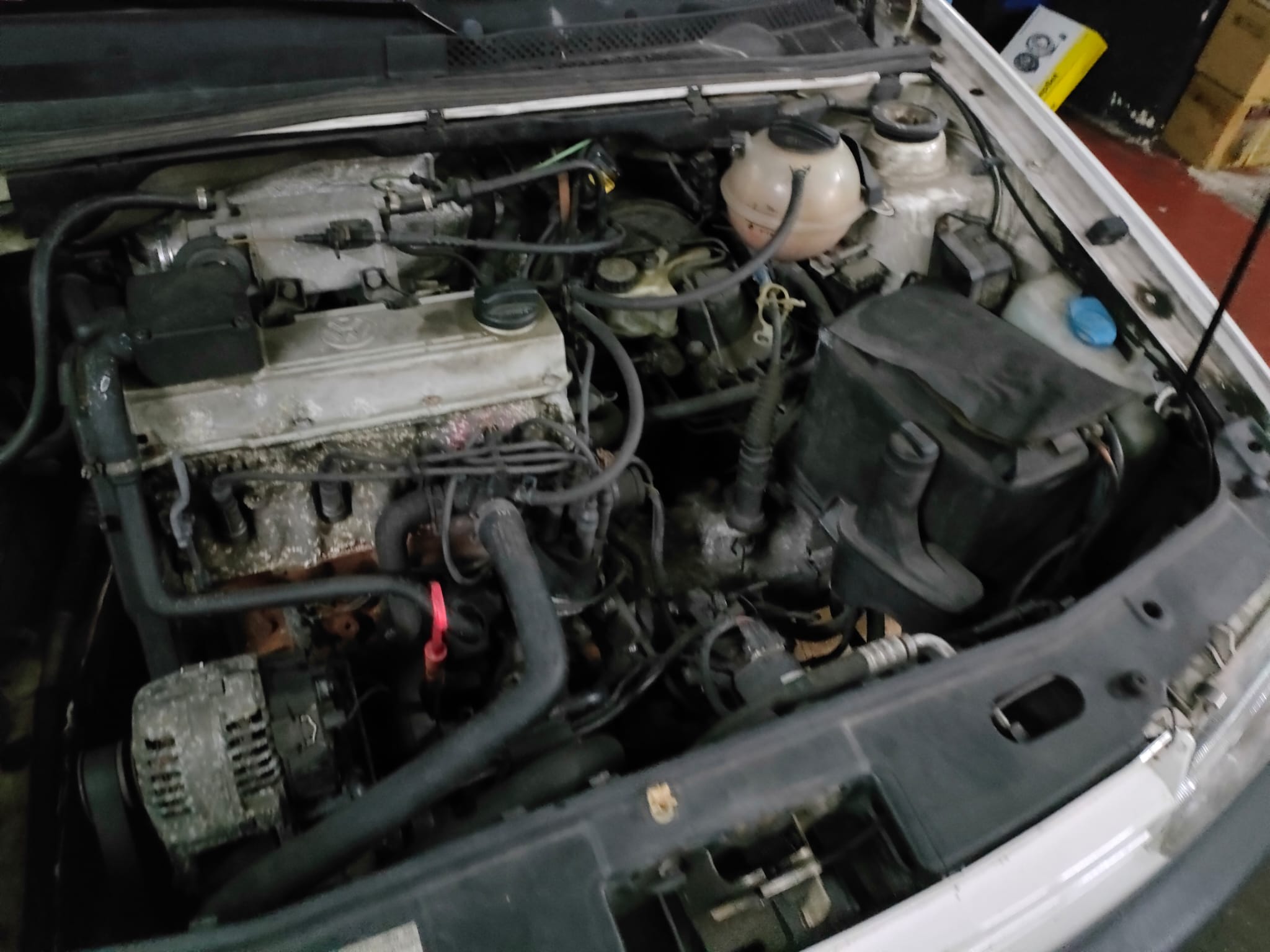
- Retire it with full honors for the services rendered.
- Restore it so it looks like in showroom condition again.
After thinking about it during a trip with my daughter to the Pyrenees in Lleida in August 2021, I decided to restore it, but with a twist. Keeping it as it is now is not an option, it would be like watching a good friend slowly fading away.
As standard the Golf MK3 GTI only has 115hp, which was a reasonable number at the time, but I have always thought this car is underpowered; in fact this is one of its biggest criticisms.
On some occasions it has crossed my mind to swap the engine and put something with much more power, therefore why not a Golf MK5 GTI (BWA) TFSI engine with 200hp. Those TFSI engines can be tuned very easily; increase power, reprogram the ECU, change injectors and turbo or upgrade many parts of the engine, where the sky is the limit. But let’s not go crazy, the objective is to carry out the swap with the original 200hp BWA engine, so the car can be road legal in Spain.
All this is not fast or cheap, in fact it is much cheaper to buy a second-hand Golf MK5 GTI. And in terms of time at the moment, I’ve been there for more than 18 months and I have not finished yet, but I’m having a lot of fun.
What is the plan?#
The plan is simple, swap the engine and make it road legal, so it can circulate through the Spanish roads.

Going a bit more into detail, this means:
- Swap existing engine for a 200hp Golf MK5 GTI (BWA) engine.
- Swap existing gearbox for a 02Q 6-speed manual gearbox.
- Improve both front near brakes, suspensions and axles.
- Make a complete body restoration, including a full respray.
- Restore the interior of the car; dashboard and seats.
All this with a basic premise; externally the car has to be as original as possible, so no body kits or modifications.
Firstly and the most important when starting a project of this type is to have a good specialised car engineer that can certify all changes made on the car are road legal and a workshop that can do the job.
From the beginning, I was lucky to have:
- Sergi Lopez (RH+ Homologaciones), an engineer specialized in car certifications who, in a very simple and quick way, explained to me what the rules of the game are to be able to make all changes road legal. In addition, Sergi will also be in charge of doing all paperwork required to make the changes road legal.
- Marc Perramon (Tallers Marc), a mechanic crazy enough to get into this mess, with a lot of experience in mechanics in general and in building custom trickers
Rules of the game for an engine swap in Spain#
First and foremost, this is neither an exhaustive nor an exact list. The regulations are complex and can change. Therefore, as I mentioned before, it is essential to have an specialized car engineer to guide and take you throughout the entire project.

Having said this, the basic rules to be able to certify swaps in Spain are:
- Intake and exhaust lines must be those of the donor vehicle.
- Front and rear brakes (diameter, disc and number of pistons) must be at least the same as those of the donor vehicle.
- The maximum power of the engine that can be installed in the receiving vehicle cannot exceed by 30% the maximum power approved for that chassis. That is to say, in my case the maximum power approved for a Golf MK3 would be the VR6 with 174hp, therefore, the maximum power that the engine of the donor vehicle can have is 226hp. This rule basically leaves me with only one choice between the engines in the Golf MK5 GTI; the 200hp BWA.
- The mounting points of the engine to the chassis must be those of the receiving vehicle. Furthermore, no changes (bending, drilling, welding, etc.) can be made to the chassis of the receiving vehicle. As an example, the exhaust line of the donor vehicle must be attached to the exhaust mounting points of the recipient vehicle.
- No less important are the weights per axle. These should not change, although it is true that there is a certain tolerance, which I think is around 5% maximum.
In my case, I have chosen the following elements:
- 2.0L TFSI BWA 200hp engine from a Golf MK5 GTI
- 02Q 6 speed manual gearbox from a Golf MK5 GTI.
- 334x32mm front discs (from a Golf MK4 R32) with 6-piston calipers
- 310x22mm rear discs with the rear calipers of a Golf MK4 R32.
These items adhere to the basic rules listed above. Surely you will wonder how the engine of a Golf MK5 is fixed to the chassis of a Golf MK3 without modifying it. The quick answer is Fabless Manufacturing, but don’t worry because I will go into detail on that later.